


North British Railway Station (typical)
North British Railway Station (typical)
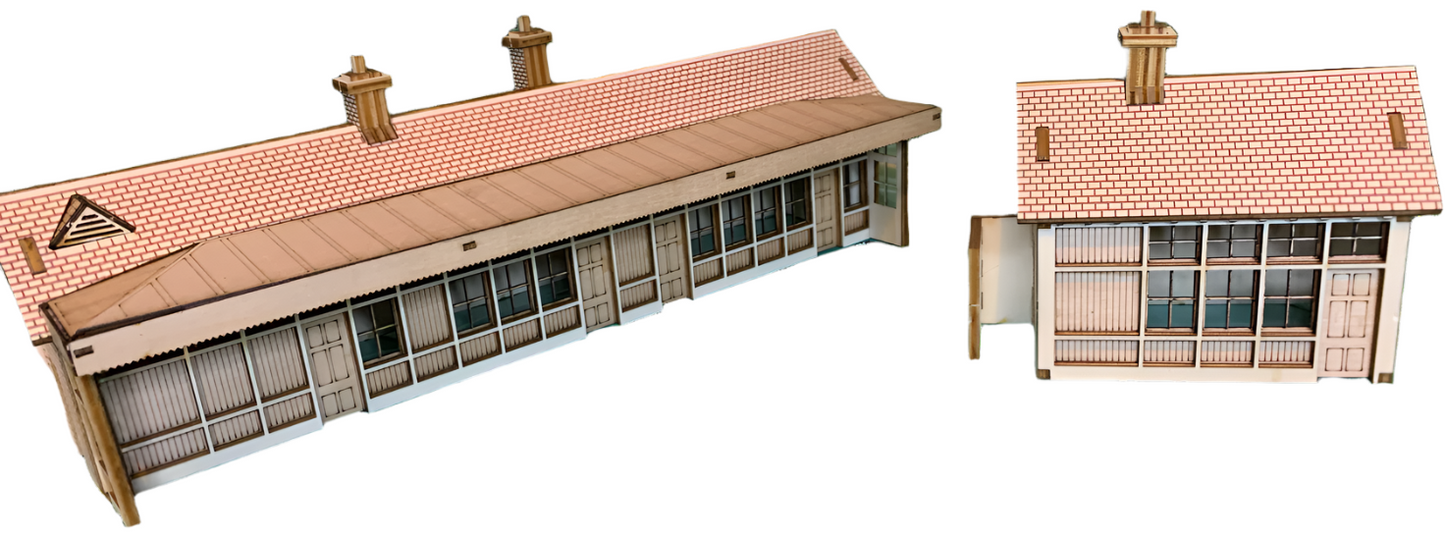
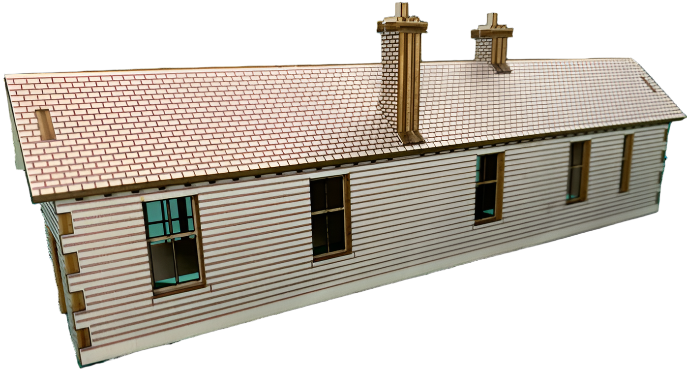
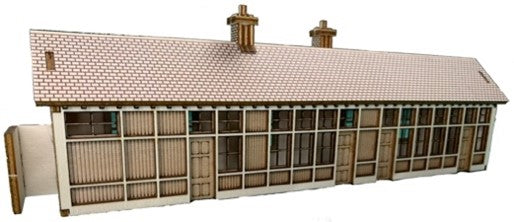
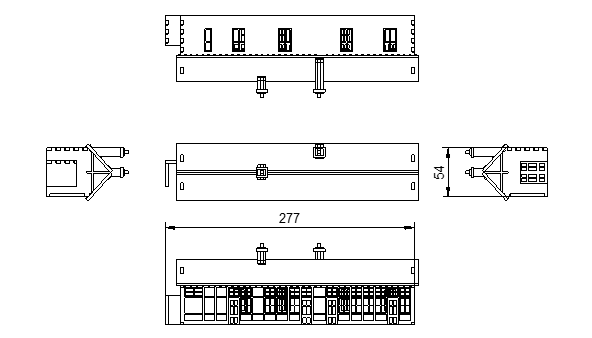
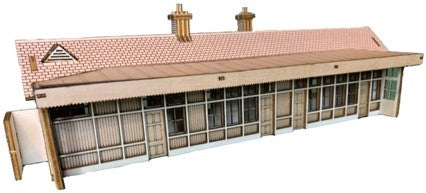
The North British Railway used a fairly standard design across many of its smaller stations. Some built in wood and some with brick and with variations in layout. The “typical” design was captured in a drawing by J. Bruce Murray which inspired this kit. The size and layout of the station and shelter is based on North East Fife stations (Luthrie & Kilmany) on the Newburgh and North Fife Railway where plans were obtained from the National Records of Scotland. These stations did not have a canopy. The design has added options based on further information from the North British Railway Study Group which adds a canopy and also adds the side screens similar to North Queensferry Station.
The kit comprises of:
- A Basic Station without canopy
- An option to add the canopy
- A further option to add side screens to the canopy
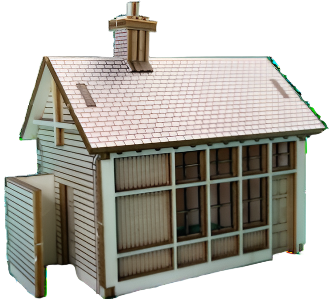
- The shelter
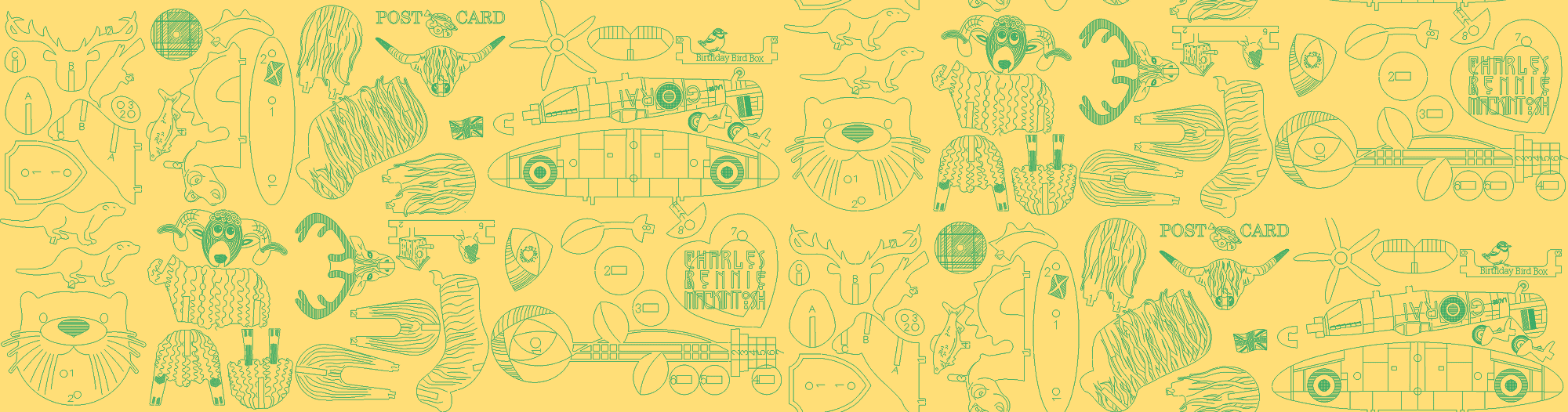
This bespoke 2xA4 laser cut 3mm plywood sheet (1xA4 of 0.8m ply) model has been designed in 1/76 scale to capture this attractive station and shelter.
The building requires glue. Choose a glue that allows at least a minute before setting to allow adjustments to be made during the build. Always test the build before using glue.
For finishing, we recommend first priming the surface, then painting with any acrylic or model paint of your choice. The material is etched, so any engraved detail such as brickwork or roof tiles will be visible after painting.
All TT:120 gauge kits are scaled to 66% of the size of the original OO gauge model. The mathematically correct conversion from OO to TT:120 is approximately 63.33%, meaning that our TT:120 models are intentionally slightly oversized.
Scaling to N gauge works well and requires no additional modifications due to the material thickness. Some parts will be very fine, so take care when removing them from the frame. If some window pieces are particularly fine, they can be reinforced by soaking them in glue before assembly.
When scaling to O gauge, some manual modifications may be required during assembly. This is due to the increased material thickness required when scaling from the 3 mm plywood used for OO gauge. At true O gauge scale, the equivalent material thickness would be approximately 5.25 mm. As this thickness of plywood is not readily available, we use the closest available thickness, 4 mm plywood.
Couldn't load pickup availability




'%3E%3Cpath fill='%235A31F4' d='M53.413.209H4.321A4.063 4.063 0 00.258 4.272v28.523a4.063 4.063 0 004.063 4.063h49.092a4.063 4.063 0 004.063-4.063V4.272A4.063 4.063 0 0053.413.209z'/%3E%3Cpath fill='%23fff' d='M32.678 14.872c0 2.663-1.867 4.564-4.476 4.564h-2.458a.206.206 0 00-.206.207v3.5a.207.207 0 01-.206.207h-1.72a.208.208 0 01-.191-.128.205.205 0 01-.016-.078v-12.63a.206.206 0 01.206-.207h4.602c2.598-.003 4.465 1.898 4.465 4.565zm-2.145 0c0-1.531-1.044-2.65-2.46-2.65h-2.329a.206.206 0 00-.206.207v4.874a.206.206 0 00.206.206h2.329c1.416.01 2.46-1.11 2.46-2.637zM33.188 20.927a2.453 2.453 0 011.026-2.104c.671-.505 1.72-.766 3.26-.82l1.64-.058v-.484c0-.97-.65-1.38-1.694-1.38s-1.706.37-1.858.975a.2.2 0 01-.198.144h-1.62a.203.203 0 01-.206-.235c.24-1.434 1.433-2.524 3.956-2.524 2.684 0 3.653 1.25 3.653 3.636v5.066a.209.209 0 01-.21.207h-1.633a.209.209 0 01-.146-.06.206.206 0 01-.06-.146v-.379a.155.155 0 00-.268-.109c-.49.533-1.281.918-2.548.918-1.864 0-3.094-.97-3.094-2.647zm5.926-1.098v-.393l-2.124.112c-1.119.057-1.77.522-1.77 1.305 0 .708.597 1.1 1.64 1.1 1.417 0 2.254-.765 2.254-2.124zM42.787 27.178V25.71a.21.21 0 01.25-.204c.25.047.505.071.76.072a1.961 1.961 0 001.975-1.4l.106-.338a.218.218 0 000-.14l-3.403-8.74a.21.21 0 01.194-.286h1.65a.21.21 0 01.194.135l2.311 6.164a.21.21 0 00.396 0l2.007-6.147a.21.21 0 01.2-.144h1.707a.212.212 0 01.197.287l-3.64 9.706c-.838 2.256-2.275 2.833-3.857 2.833-.3.008-.6-.028-.89-.107a.212.212 0 01-.157-.223zM12.352 9.579a8.475 8.475 0 00-5.844 2.28.37.37 0 00-.046.495l.981 1.34a.375.375 0 00.573.045 6.063 6.063 0 014.344-1.775c3.364 0 5.121 2.532 5.121 5.032 0 2.718-1.846 4.63-4.499 4.668-2.05 0-3.595-1.359-3.595-3.154a3.065 3.065 0 011.133-2.365.37.37 0 00.051-.516L9.54 14.327a.376.376 0 00-.536-.055 5.448 5.448 0 00-2.03 4.238c0 3.09 2.626 5.514 5.99 5.534h.045c3.994-.052 6.882-3.01 6.882-7.053 0-3.59-2.644-7.412-7.538-7.412z'/%3E%3C/g%3E%3Cdefs%3E%3CclipPath id='clip0'%3E%3Cpath fill='%23fff' d='M0 0h57.699v37H0z'/%3E%3C/clipPath%3E%3C/defs%3E%3C/svg%3E)